
925 Silver Jewelry: Why the Minimum Is Lower
Silver, brass and stainless steel are not priced by the same rules, and the difference shows up first in the minimum. Published floors are 100+ in stainless work, 100 pieces in the eco-brass line and 50 in sterling silver, by design, with each design counted separately. Silver is the least costly metal to tool, the fastest to finish and the only one of the three that carries an MOQ a small brand can fund.

Key takeaways
- Minimum order quantities are 100 in eco-brass, 50 pcs in sterling silver and 100+ pcs in the stainless line, for each design quoted per design.
- Silver is quick to tool and quick to finish, which is what allows the lower floor rather than any pricing policy.
- Plated silver and brass carry a protective anti-tarnish e-coating; stainless steel is finished with PVD vacuum plating.
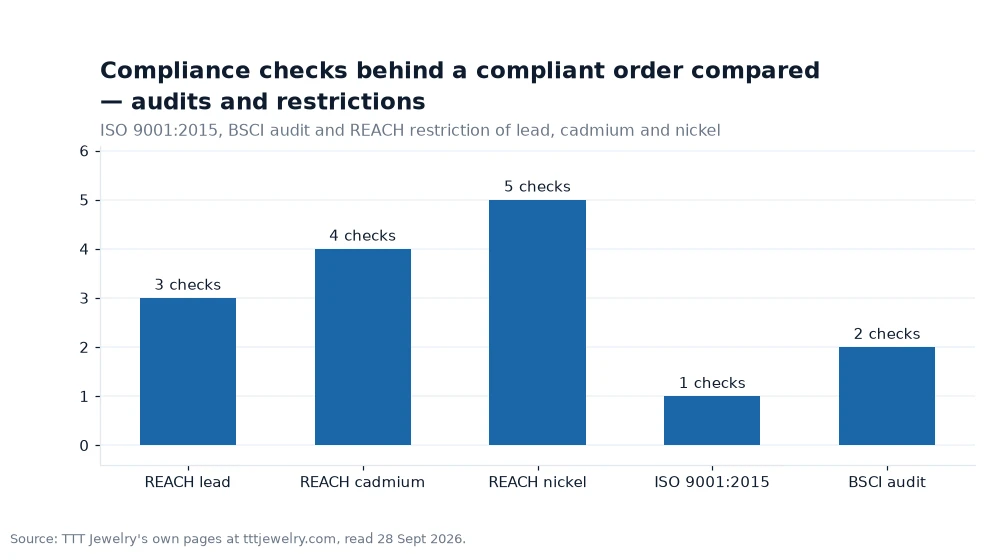
- Compliance sits on three published documents: A BSCI audit, a REACH statement covering lead, cadmium and nickel and the ISO 9001:2015 standard, cadmium and nickel.
The tooling reason behind the 50-piece floor
A minimum exists to cover the work in front of the first piece: the mould, the setup, the polishing wheel time and the plating tank loading. Silver casts cleanly and polishes quickly, so the setup cost is spread over fewer pieces before the order makes sense. Brass needs a plating stack before it looks like a finished product, and stainless steel machines harder, which pushes both materials up.
That is why the floor is a material fact rather than a sales decision. Asking a factory to drop a silver minimum to 25 pieces is asking it to run a batch below the point where the tooling pays back.
What the higher minimums actually buy
Brass at 100 pieces buys a plated look at a lower unit metal cost, which suits a fashion line where volume matters more than the alloy. Stainless steel at 100+ buys wear resistance and a PVD finish that survives daily contact, which suits pieces sold on durability rather than on precious metal content.
Choosing between them is a question about the retail channel. A jewellery counter expects a purity hallmark; a lifestyle marketplace listing expects the piece to survive a swimming pool.
Compliance is the other half of the decision
The published materials statement is REACH compliance covering lead, cadmium and nickel, with plating described as compliant with REACH and CA Prop 65. Those three restricted substances are the ones that turn up in plating chemistry, which is why the statement belongs with the plating specification.
Alongside it sit two process documents. ISO 9001:2015 covers the quality management system across production stages, and a BSCI audit covers labour practices, working conditions and the supply chain. Buyers in the EU tend to ask for the two separately, so keep them as separate files.
Silver adds four published details to that compliance picture: every piece stamped S925, an alloy described as nickel-free and allergy-free, eco-friendly electroplating applied on a 925 base, and the same quality block naming ISO 9001:2015, BSCI and REACH. Sample testing before production is listed as a service, which is what makes the alloy claim checkable rather than aspirational.
Where the minimum bites in a real range plan
Every design carries its own minimum, and they do not average. Two silver designs are 2 × 50 = 100 pieces; two brass designs are 2 × 100 = 200; two stainless designs are at least 2 × 100 = 200. A mixed range is the sum of each line, not a blended figure.
Brands ready to explore silver collections in quantity usually count designs before they count pieces, because the floor applies to each design separately. That is why a first collection usually starts in one material. Silver at 50 pieces per design lets a brand test four designs for 200 pieces, which is a realistic first order for a shop, a market stall or a web store.
| Material | Minimum per design | Finish route |
|---|---|---|
| 925 sterling silver | 50 pcs | Gold or rhodium electroplate, plus anti-tarnish e-coating |
| Artisan eco-brass | 100 pcs | Gold or rhodium electroplate, plus anti-tarnish e-coating |
| Stainless steel | 100+ pcs | PVD vacuum plating |
| REACH | Lead, cadmium, nickel | Applies to materials and plating |
| ISO 9001:2015 and BSCI | Process and social audit | Applies to the whole site |
Worked example: the silver floor as a share of the others
Put the three minimums side by side. Silver is 50, brass is 100 and stainless steel is 100+. Against brass, silver is 50 ÷ 100 = 50% — half the commitment for the same design. Against stainless, the same calculation holds at the published 100 floor, and rises above it once the 100+ wording is taken literally.
Turn it into a range: a fixed budget of 300 pieces buys 300 ÷ 50 = 6 silver designs, 300 ÷ 100 = 3 brass designs or 300 ÷ 100 = 3 stainless designs. Six designs against three is the practical argument for opening in silver, before any consideration of the price the customer pays. The minimums are published; the divisions are mine.
When a higher minimum is still the right answer
If the design is a plated statement piece with a low unit cost, brass at 100 pieces is the correct floor, because the sales volume comes from price rather than from metal. If the piece has to be worn in water and heat, stainless steel at 100+ removes an entire category of returns.
The mistake is choosing a material by unit cost alone and then discovering that the minimum absorbs the saving. Multiply the minimum by the unit price before comparing anything.
Sizing a first order around the silver floor
The floor is per design, so the fastest way to plan is to count designs and multiply. Four designs at 50 pieces each is 200 pieces; add a fifth and the order grows by 50, not by a percentage. Keeping a spreadsheet column for designs and another for pieces per design makes the total visible before the enquiry is sent.
Size splits then go inside the design minimum, not around it. A ring design at 50 pieces across five sizes is 10 pieces per size, which is a real constraint on a slow-moving size and no constraint at all on the middle of the range. Buyers who plan sizes from their own sales history rather than an even spread get a better first order out of the same 50 pieces.
The reorder decision follows the same arithmetic. Since the floor does not fall on a second run, a proven design is reordered at 50 pieces while the size mix is adjusted upward. Nothing about the minimum makes a small brand an inconvenience; it makes the range plan a multiplication exercise.
Frequently asked questions
Why is the silver minimum lower than the brass minimum?
Because 925 sterling silver casts cleanly and finishes quickly, so the tooling and setup cost is covered by fewer pieces; brass requires a plating stack and stainless steel is harder to machine.
Is 925 sterling silver compliant with REACH?
The published statement covers freedom from lead, cadmium and nickel, and describes the plating as compliant with REACH and CA Prop 65 standards.
Can minimums be split across colours or sizes?
Minimums are quoted per design per order, so a single design ordered in two plating colours still has to meet the minimum for that design.
Choosing the material before the metal order
Fix the material first, because it sets the minimum, the finish route and the compliance questions in one move. Then let the design work follow, and the 25–30 day sampling window is spent on a piece that is already commercially viable rather than on one whose quantity is still open.
A brand scaling a line should check the published minimums against its own cash flow before adding a second material to the plan; the wholesale ordering notes explain how the per-design floors stack when one order covers several designs, and the step list on the factory page shows which operations change with the metal.
The figures used above — the eco plating route together with the ISO 9001:2015, BSCI and REACH claims as well as the packaging list — are drawn from tttjewelry.com, checked 28 Sept 2026. The chart's relative scale is my own, not the site's[1].