
Before You Sign: Four Things a Private Label Factory Must Show You
If you are placing a first private label order, the useful question is not whether the factory seems professional but whether it can show you four things: the product it will make, the documents that will travel with it, the person who owns your project, and the terms that govern what happens if something changes. A factory that can demonstrate all four is a safer partner than one with a longer client list. Everything else, including price, is easier to compare once those four answers are on the table.
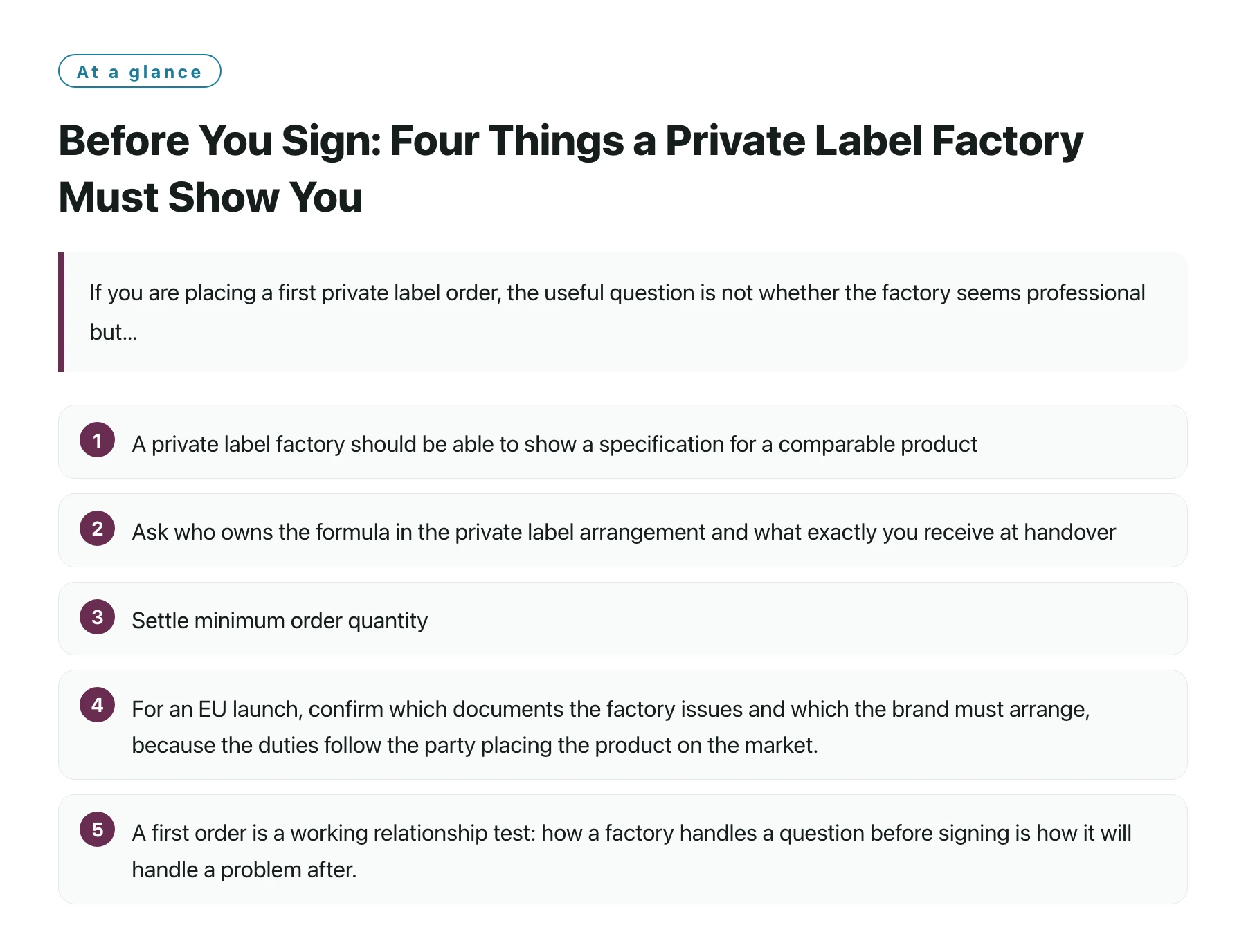
Key takeawaysA private label factory should be able to show a specification for a comparable product, dated and versioned, before you sign anything. · Ask who owns the formula in the private label arrangement and what exactly you receive at handover, because the answer defines what you can do later. · Settle minimum order quantity, sample rounds, artwork responsibilities and change fees in the agreement rather than in conversation. · For an EU launch, confirm which documents the factory issues and which the brand must arrange, because the duties follow the party placing the product on the market. · A first order is a working relationship test: how a factory handles a question before signing is how it will handle a problem after.
Most first-time founders arrive at a private label conversation with a mood board, a rough budget and a launch date that assumes everything goes smoothly. That is a reasonable starting position, and it is also the position from which expensive mistakes are made, because the decisions that matter at this stage are not creative ones.
This guide is written for someone signing a fragrance manufacturing agreement for the first time, with no sourcing or regulatory background. It assumes you have chosen to work with a private label perfume factory, which means the factory supplies an existing or adapted scent under your brand, and it focuses on what you should be shown rather than what you should say.
Read it as a pre-signing checklist. Each item corresponds to a question you can ask in a call and a document you can request by email, and none of them require technical knowledge to evaluate.
Ten questions worth asking before you sign
- Which product will you actually make for us?Ask for the specification of a comparable product with the customer name removed. A dated, versioned document tells you more about the factory than a catalogue.
- Who owns the scent in a private label arrangement?Private label normally means the factory owns the formula and licenses you to sell it under your brand. Confirm in writing what happens if you later want exclusivity or a modified version.
- What exactly do we receive at handover?Ask for the list: finished goods, batch documentation, artwork files, and any specification you are allowed to hold. Vague answers here become disputes later.
- What is the minimum order quantity, and what drives it?Minimums usually come from the pack rather than from the liquid. Ask which component sets the number and whether a stock alternative would reduce it.
- How many sample rounds are included?Get the number in writing, along with the cost and the calendar impact of each additional round, so a third revision does not become an unbudgeted month.
- Who approves artwork, and who checks the label?Allergen and ingredient wording comes from the formula and the product type. Confirm who produces the wording and who is responsible for checking the printed label.
- What documents travel with the shipment?Ask for the standard document pack and a sample certificate of analysis. For an EU launch the technical inputs behind the safety assessment are part of the product, not an extra.
- What is the production and delivery calendar?Ask for the batch date for your volume, not a general lead time, and ask what would move it. Then build your launch plan around the answer.
- What happens if we need a change after the sample is approved?Ask how a formula, pack or quantity change is handled, who approves it and what it costs. This is the clause most first-time buyers forget to negotiate.
- Who is our contact, and how often will we hear from them?A named owner with a defined update rhythm is the least expensive project management you will ever buy, and it should be part of the agreement.
What belongs in the agreement, and why
| Clause | What it should say | What it protects |
|---|---|---|
| Formula ownership and licence | Who owns the scent, what the brand may do with it, and whether exclusivity is available | Your freedom to scale, modify or move the product later |
| Specification revision control | Any change to the formula or the pack requires written notice and a new version number | Label wording, the safety assessment and the approved sample staying aligned |
| Sample rounds and approvals | Number of included rounds, cost of extras, and what constitutes approval | Budget and calendar predictability |
| Document pack at delivery | Named documents, issued with each batch, in a defined format | Retailer requests, distributor checks and your own compliance file |
| Minimum quantity and tolerance | The minimum, what sets it, and the acceptable over or under delivery | Cost planning and stock accuracy |
| Change and cancellation fees | What a mid-project change costs, and at which stage it becomes expensive | Protection against surprises after deposit |
| Project owner and communication | Named contact, response expectations and the channel for technical questions | Decisions being answered rather than accumulating |
You do not need all seven clauses to be elaborate. You need them to be written, dated and signed, because an agreement that exists only in an email thread is difficult to rely on when a deadline is close.
How to check the answers without technical knowledge
You do not have to evaluate a formula to evaluate a factory. Three habits do most of the work. First, ask for documents rather than descriptions and read only the parts you understand: whether the paper is dated, whether it has a version number, whether the product type is named. Those three details tell you whether a document control system exists.
Second, ask the same question twice, in different conversations. If the minimum quantity or the sample policy changes between calls, the answer was never fixed. That is useful information before signing rather than after.
Third, ask what the factory does not do. Every manufacturer subcontracts something, whether it is glass, printing, carton assembly or testing. A supplier that openly names those boundaries is easier to work with than one that claims to cover everything, because you know where the handover points are.
For an EU launch there is one more check worth making, and it is about substance restrictions rather than branding. Permitted use of fragrance materials depends on the product type, and the ingredient database maintained by the European Commission is the reference that determines those conditions [1]. A factory should be able to tell you which of your candidate materials are affected and how it verifies that during production. If that question produces a blank look, the documentation pack is likely to be thin as well. A related question is worth asking if your range will grow: understanding the difference between white label fragrance manufacturing and a bespoke development decides how much of the second collection you can adapt rather than create from scratch.
The two checks that separate similar quotations
Quotations from private label suppliers often look almost identical because the headline price is not where the difference lives. Put the two documents side by side and compare four lines: what is included in the unit price, what is quoted separately, what triggers a surcharge, and what the minimum quantity commits you to. A lower unit price with separate decoration, testing and sampling charges is frequently the more expensive option for a first order.
The second check is the sample policy measured in time rather than money. Ask how long a round takes from brief to parcel, and who is responsible for the delay if feedback is slow. A factory that answers in days and gives you a written response rhythm is easier to plan a launch with than one that promises a perfect first sample.
Both checks are easier when you know what a quotation is made of. If you are comparing two suppliers and the totals differ without an obvious reason, reading a perfume price breakdown is worth doing before you decide, because most of the negotiating room in a private label proposal sits in the lines rather than in the total.
It also helps to see the whole project once before you commit. A short account of what it takes to launch a perfume brand, from brief to shelf, is a cheap way to find the steps you had not planned for, and it makes the questions above easier to place in sequence.
None of this requires a technical background. It requires asking for paper, comparing it the same way across suppliers, and being willing to walk away from a conversation where the answers keep moving.
A simple test before you commit a deposit: send one written question by email and note how long the reply takes and whether it answers the question asked. A first order is a sequence of a hundred small exchanges like that one, and the quality of the first is a reasonable forecast of the rest.
Sources
- EU CosIng — Cosmetic Ingredient Database (European Commission) —— The European Commission's CosIng database of cosmetic ingredients, listing ingredient functions, restrictions and labelling requirements under EU cosmetics law.
Frequently asked questions
What is the difference between private label and white label for perfume?
The terms are often used interchangeably. In practice, private label means the factory supplies a scent under your brand, while white label usually refers to a standard product that several brands sell under different names. Ask directly which one you are being offered.
Do I own the formula after a private label order?
Usually not by default. Ownership and exclusivity are negotiated, so confirm in writing who owns the scent, what you may do with it and whether a competitor could be sold the same version.
How much deposit is normal for a first order?
Payment terms vary by supplier and by market, and they usually tie to order confirmation and shipment. What matters is that the schedule, the deliverables and the change costs are in writing before the first payment.
What if the factory cannot tell me about EU ingredient restrictions?
Treat it as a signal about its documentation capability rather than only about the formula. Restriction checks are routine for suppliers used to regulated markets, and a blank answer suggests the compliance work would fall to you.
Should I visit the factory before signing?
A visit is useful if it is practical, but a video walkthrough that includes the filling area and the retained sample store can answer most of the same questions. What matters is seeing the process rather than the showroom.
Hold a piece of the Himalayas.
Every certified aquamarine is hand-cut in our Kathmandu lapidary and shipped direct — averaging 58% below Western retail.
Shop Certified Aquamarine